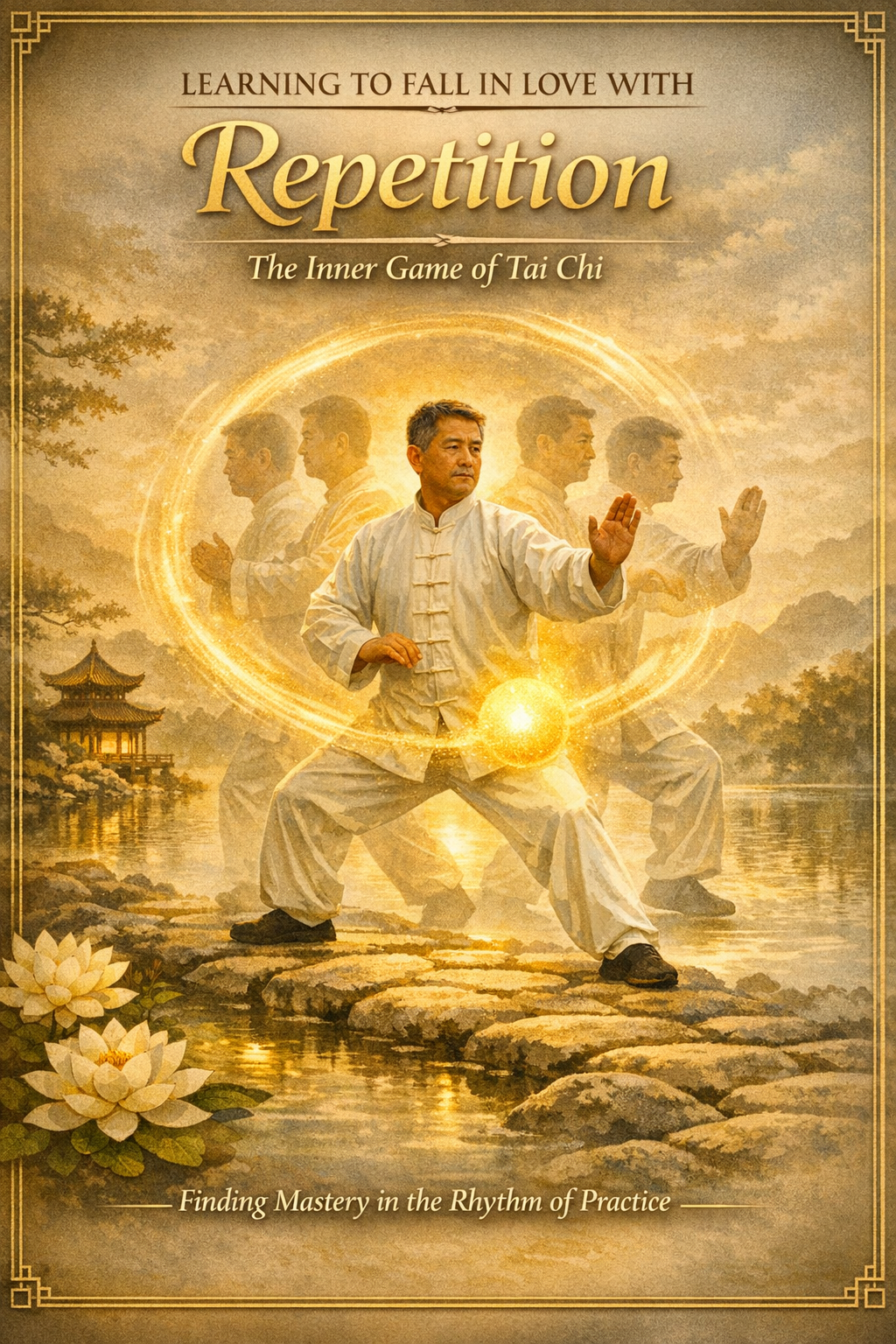
Learning to Fall in Love with Repetition: The Inner Game of Tai Chi

There is a moment every Tai Chi student faces, usually a few weeks or months into learning, when the initial excitement fades, and the work begins to feel repetitive. The same forms, the same corrections, the same slow movements again and again. This is the moment that separates those who continue from those who stop.
What the masters know — and what students gradually discover — is that repetition in Tai Chi is not a barrier to progress. Repetition is the practice. Each time you move through a form, you are not simply going through motions. You are teaching your body, calming your nervous system, and deepening your understanding of balance and energy.
This is why experienced practitioners speak of Tai Chi as a lifelong study. Even after decades, a master will return to the most basic movements and find new layers of understanding within them. The form does not change; the practitioner changes. What once required intense concentration eventually becomes fluid and natural, and in that fluidity, deeper work becomes possible.
Learning to embrace repetition requires a shift in mindset. Instead of asking 'When will I be good enough?', the more useful question is 'What am I noticing today that I did not notice before?' This curiosity transforms routine practice into genuine exploration.
Keeping a practice journal can support this mindset. Writing a few sentences after each session — noting what felt difficult, what felt smooth, and any insights or questions that arose — creates a record of growth that is invisible in the moment but unmistakable when read over time.
Discipline and repetition, in the context of Tai Chi, are not sacrifices. They are gifts you give to your future self. Every hour of practice is an investment in a body that moves with ease, a mind that stays calm under pressure, and a spirit that knows how to be still.