The Art of Mindful Walking: A QISYNC Foundation Practice

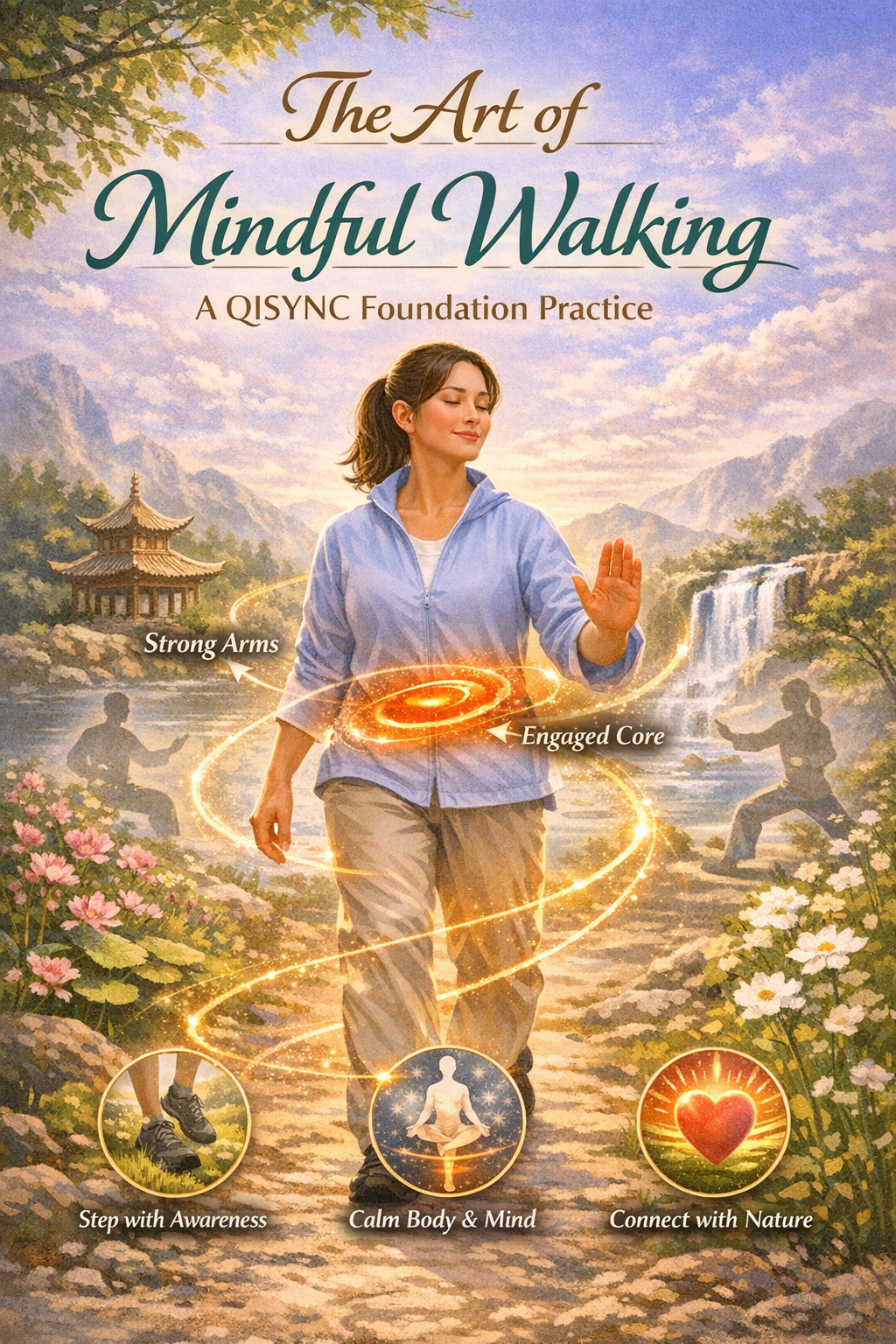
Among the many principles that define the QISYNC path, one stands out for its simplicity and accessibility: integrating practice into everyday life. While many disciplines reserve their teachings for the training floor or the meditation cushion, QISYNC recognises something far more profound — that every moment of daily life is an opportunity to cultivate awareness, build energy, and deepen the mind-body connection.
And it begins with something as ordinary as walking.
Every Step, a Practice
We walk every day without thinking. From the bedroom to the kitchen, from the car to the office, from one room to the next — our feet carry us through life almost entirely on autopilot. The mind wanders, lost in thought, planning, worrying, replaying. The body moves, but we are rarely inside it.
QISYNC invites us to reclaim these forgotten moments.
The practice is disarmingly simple: as you walk, bring your full attention to the rhythm of your steps. Count silently to yourself — one, two, three, four — and repeat. Nothing more. No special equipment, no dedicated time set aside, no retreat required. Just you, your steps, and your awareness.
Yet within this simplicity lies extraordinary depth.
The Mind-Body Connection: Why It Matters
Modern life has created a peculiar disconnection. We live predominantly in our minds — consumed by screens, schedules, and an endless stream of information — while our bodies go largely unnoticed. We feel tension only when it becomes pain. We notice our breath only when it becomes laboured. We sense our posture only when it causes discomfort.
This disconnection is not merely an inconvenience. In the framework of QISYNC, it represents a fundamental disruption of the flow of Qi — the vital life energy that moves through and animates the body. When the mind is elsewhere, energy stagnates. When awareness returns to the body, energy begins to flow.
Mindful walking is one of the most direct and practical ways to restore this connection. By anchoring the mind to the rhythm of the steps, we draw attention back into the body. We begin to feel the ground beneath our feet, the subtle shift of weight from one leg to the other, the gentle movement of the arms, the rise and fall of the breath. Gradually, the body stops being something we carry around and becomes something we inhabit.
Cultivating Energy Through Awareness
In QISYNC, energy — or Qi — is not something exotic or mystical. It is the natural vitality that arises when the body is relaxed, the mind is present, and movement flows without tension or resistance. It is the aliveness you feel in moments of deep calm or quiet focus.
Mindful walking cultivates this energy in a subtle but consistent way. Each time you bring your attention back to your steps, you are practising energetic cultivation. You are training the mind to settle, the nervous system to regulate, and the body to move with greater ease and efficiency.
Over time, practitioners report a remarkable shift. What begins as a simple counting exercise gradually evolves into a felt sense of presence — a quiet, steady awareness that accompanies movement. The body begins to feel more alive, more responsive, more connected. Energy that was once scattered by distraction is gathered and made available.
Sharpening Clarity
There is another dimension to this practice that is equally valuable: cultivating mental clarity.
When the mind is given a simple, rhythmic anchor — one, two, three, four — it has something to return to each time it wanders. And it will wander. Thoughts will arise, distractions will pull, the mind will drift. This is natural and expected. The practice is not to force stillness, but to gently and repeatedly return.
Each return is a moment of clarity. Each moment of clarity, however brief, is a small victory over the habitual restlessness of the mind. Practised consistently, this trains a quality of attention that extends far beyond the walk itself. Students often find that over weeks and months, their thinking becomes cleaner, their reactions more measured, and their capacity to focus noticeably stronger.
In this sense, mindful walking is a form of moving meditation — accessible to anyone, at any time, without the need to sit still or clear the mind completely.
Preparing the Body for Tai Chi
For students engaged in Tai Chi practice, mindful walking serves a deeper and more specific purpose. Tai Chi demands a quality of embodied awareness that cannot simply be switched on when the class begins. It must be cultivated continuously, woven into the fabric of daily life.
The slow, deliberate movements of Tai Chi require the practitioner to feel subtle shifts in weight, sense joint alignment, and detect where tension is held and where energy moves freely. These are not skills that can be developed in one hour a week. They require an ongoing, lived relationship with the body.
Mindful walking builds exactly this. By regularly tuning into the body during something as simple and familiar as a walk, the student trains the very faculties that Tai Chi asks of them — presence, sensitivity, coordination, and the ability to sense internal movement. When they step onto the practice floor, they are not starting from zero. They bring with them an accumulated depth of bodily awareness, ready to be refined and elevated.
Making It a Daily Habit
The beauty of this practice is that it requires no time sacrifice. It asks only for a shift in attention — a conscious choice to be present with what is already happening.
Begin with short walks. A walk to the mailbox, across a parking lot, down a corridor. For just these few steps, let the counting become your anchor. One, two, three, four. Feel your feet. Feel the ground. Let everything else recede, just for a moment.
As the practice becomes familiar, extend it. A morning walk around the neighbourhood, fully present. A lunchtime stroll, unhurried and aware. Even the short walk from the desk to the door can become a moment of practice, a quiet return to the body, a cultivation of energy.
Over time, the counting may become less necessary. Awareness may arise naturally with movement, a quiet companionship between mind and body that no longer requires effort to maintain. This is the fruit of consistent practice — not a dramatic transformation, but a gradual, deepening aliveness that enriches everything it touches.
Conclusion
QISYNC teaches us that the path is not separate from daily life — it is woven through it. The training hall is everywhere. The practice is always available. And it begins, humbly and powerfully, with the very next step you take.
Walk mindfully. Count your steps. Return, again and again, to the body beneath you. In this simple act, the foundation of everything is being laid.