Understanding the Yin-Yang Philosophy in Tai Chi

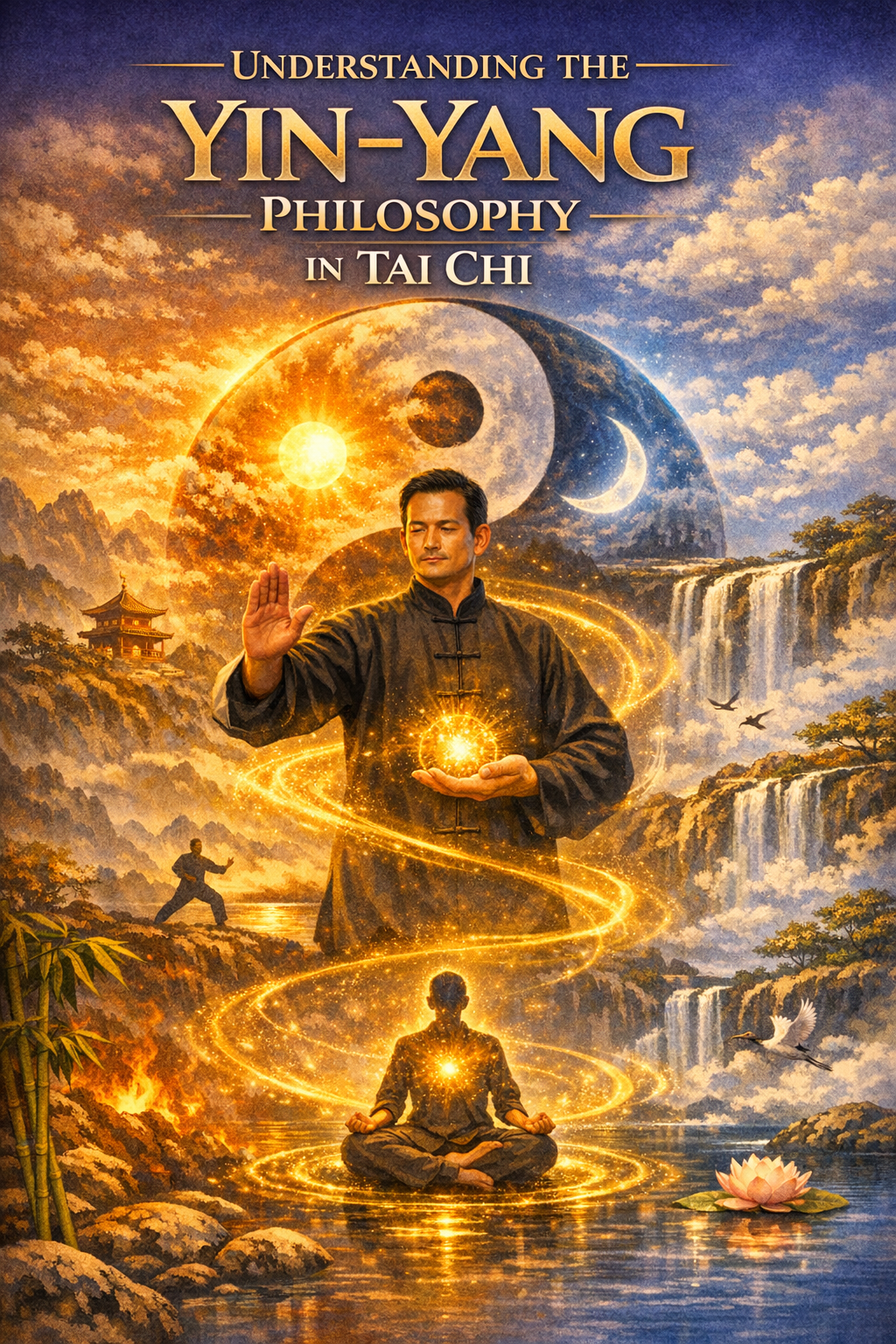
The Heart of Tai Chi Philosophy
At the core of Tai Chi Chuan lies one of the most enduring philosophical concepts in Chinese culture: the principle of Yin and Yang. This idea — that all things consist of two opposing yet complementary forces — is not merely abstract theory. It is the living framework through which every Tai Chi movement is understood and practiced.
What Yin and Yang Mean
Yin and Yang describe opposite qualities that exist in dynamic balance: dark and light, stillness and motion, softness and firmness, yielding and asserting. Neither quality can exist without the other, and each contains the seed of its counterpart. In the iconic Taiji diagram, the two swirling halves reflect this continuous interplay.
Yin and Yang in Movement
In Tai Chi practice, every action embodies this duality. As the body inhales (Yin), it prepares to exhale (Yang). As weight shifts onto one leg, the other becomes light. As one arm extends, the other withdraws. This constant interplay of opposite forces creates the distinctive quality of Tai Chi movement — rooted yet flowing, powerful yet relaxed.
Balance as a Health Principle
The philosophy of Yin and Yang also informs the health dimension of Tai Chi. Many imbalances in the body and mind — tension, anxiety, fatigue, stiffness — can be understood as an excess of one quality or a deficiency of the other. By practicing the balanced interplay of opposing forces through movement and breath, Tai Chi helps restore equilibrium at every level.
A Living Philosophy
What makes Yin-Yang philosophy so powerful is that it is not abstract — it is felt directly in the body during practice. Over time, practitioners develop an intuitive sense of balance, learning to yield when force is applied and to act when the moment is right. This wisdom, cultivated through movement, gradually permeates daily life.