Using the Breath as an Anchor — How Qigong Develops Unshakeable Present-Moment Awareness

Ask a beginner what they're supposed to focus on during a Qigong practice, and there's a good chance they'll look a little overwhelmed. Focus on the movement? The energy? The meridians? The posture? Where exactly do I put my mind? This confusion is very common, and it has a beautifully simple answer: start with the breath.
In Qigong, the breath is not just a biological process. It's a bridge — the most direct connection between your conscious mind and your body's deeper intelligence. When you bring genuine attention to your breath, you automatically arrive in the present moment. You can't breathe in the past or the future. The breath is always now. This makes it one of the most reliable anchors for developing the kind of steady, present awareness that is central to both Qigong and Tai Chi.
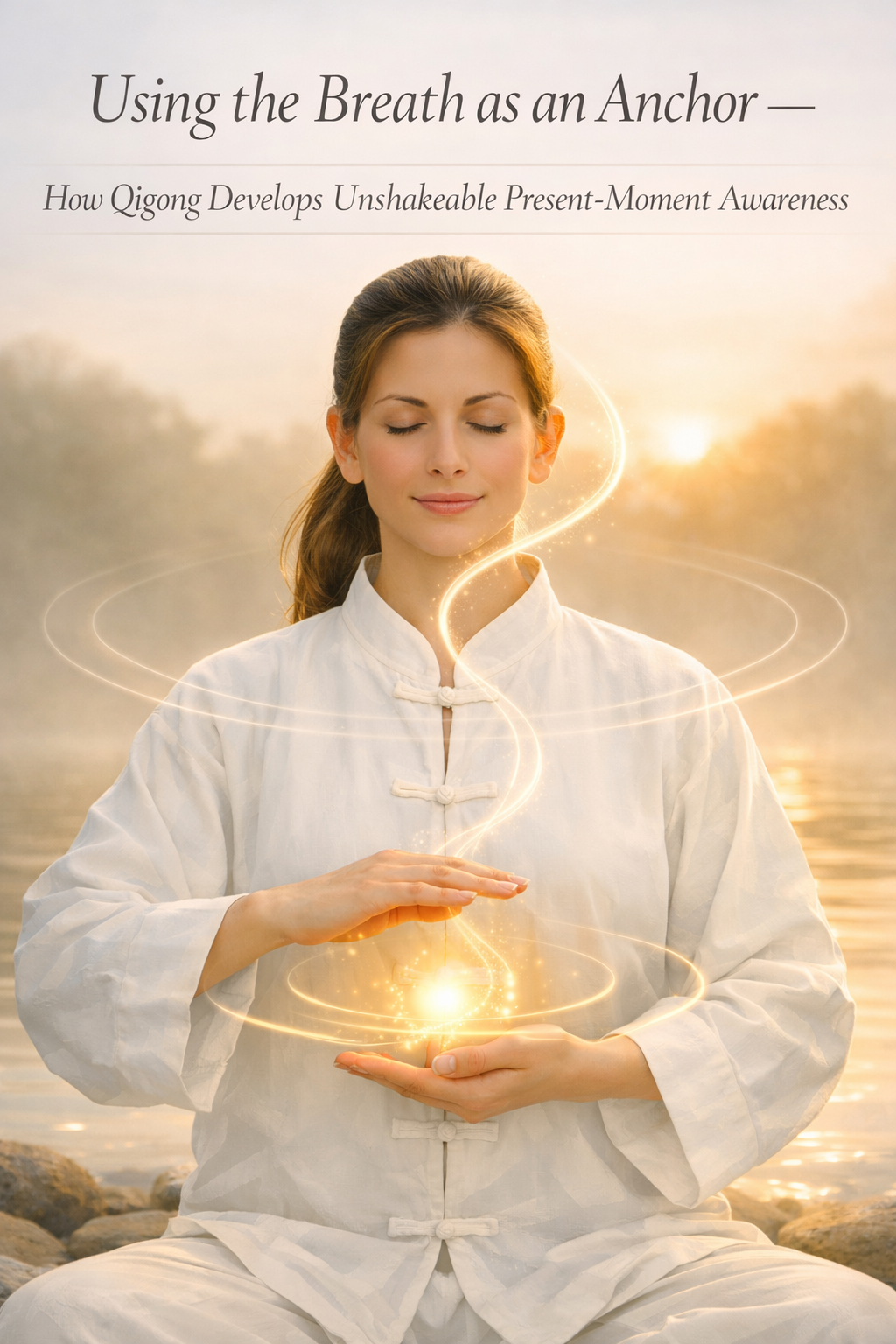
The foundational breathing technique in Qigong is abdominal breathing, also called Dan Tian breathing. Here's how to begin. Sit or stand comfortably, and place one hand on your lower abdomen, just below your navel. As you inhale through your nose, allow your lower abdomen to expand outward, like a balloon gently filling. Your chest should stay relatively still. As you exhale — slowly, through the nose or softly through the mouth — let the abdomen naturally contract. That's it. No forcing, no dramatic breath-holding. Just a slow, full, natural cycle.
For most beginners, this is already a revelation. Many people have been shallow chest-breathers their entire lives, never bringing breath all the way down into the body's centre. The first time you breathe deeply into the abdomen, you may notice an immediate sense of settling — a kind of physical dropping-down into yourself. That's not imagination. That's your nervous system beginning to shift from alert mode into a calmer, more regulated state.
What makes this practice so powerful for attention training is its simplicity. Your only job is to feel the breath moving in and out. When your mind wanders — and it will — you simply notice that it has wandered, and you return to the breath. This return, repeated over and over, is the training. Breath awareness meditation practised in Qigong has been shown to reduce stress and anxiety, improve focus and concentration, and enhance self-awareness. These aren't side effects. They're the direct result of training your attention to rest stably on a single point.
As your practice develops, you'll begin coordinating your breath with your Qigong movements. Inhales are paired with expanding, opening gestures. Exhales accompany contracting, closing ones. This coordination creates a rhythmic flow that deeply calms the nervous system and brings a quality of unified attention — mind, breath, and body moving as one — that practitioners describe as deeply satisfying. It's not a dramatic experience. It's a quiet wholeness. And it begins with something as simple as one conscious breath.