What Is Attention Stability — and Why Tai Chi Is the Perfect Place to Start

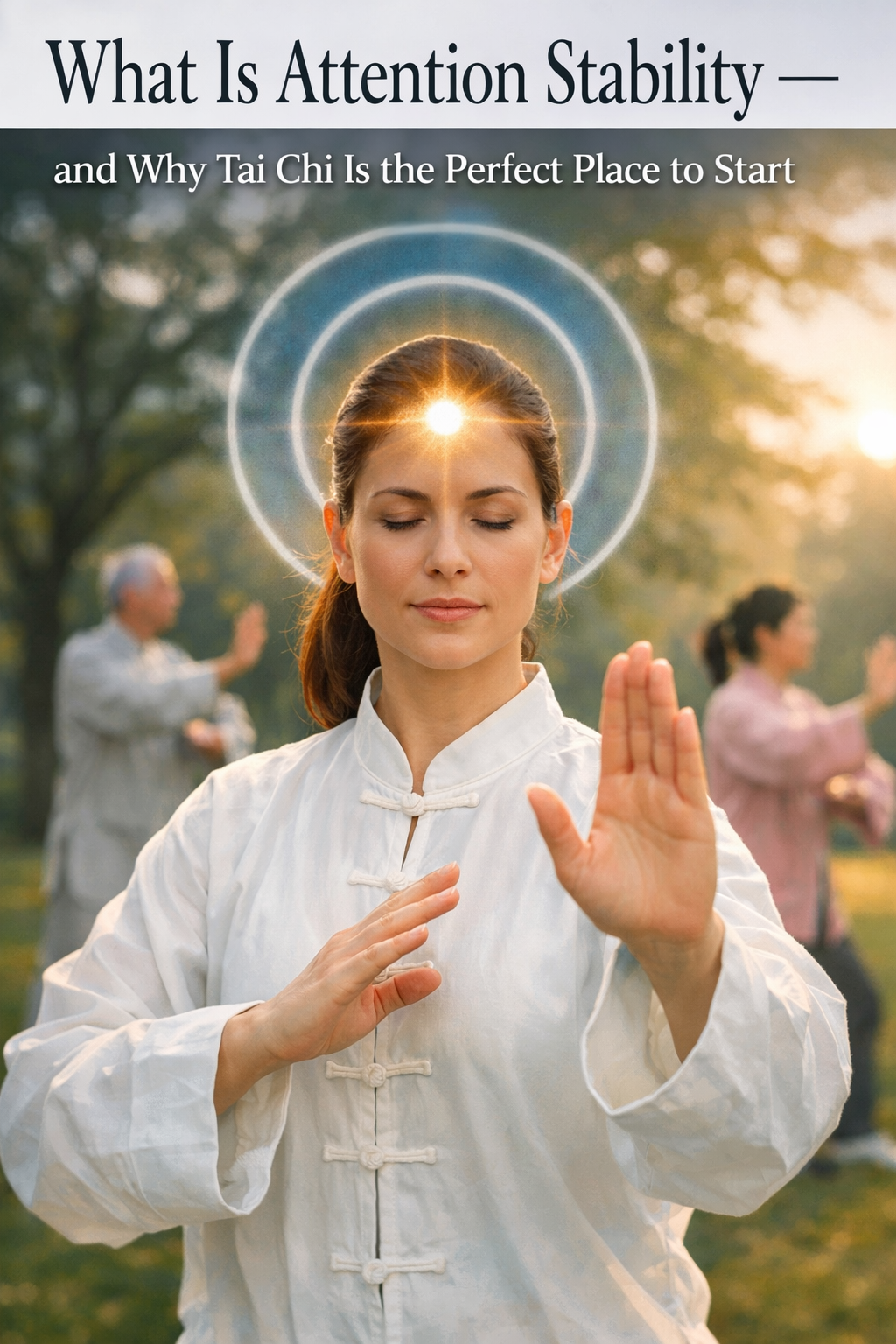
If you've ever sat down to do something important and found your mind drifting to three other things within the first two minutes, you're already familiar with what it feels like to have unstable attention. It's not a character flaw — it's just what an untrained mind does. The good news is that attention is a skill, and like any skill, it can be developed with the right practice. Tai Chi is one of the most effective and accessible ways to start, even for complete beginners.
So what exactly is attention stability? Simply put, it's the ability to keep your focus on what you've chosen — without being constantly pulled away by thoughts, sounds, emotions, or random mental chatter. It doesn't mean you become robotic or blank. It means you develop a quiet steadiness, a kind of inner anchor, that lets you stay present even when life around you is busy.
Tai Chi trains this quality in a very direct way, and the reason is built into the practice itself. Every movement in Tai Chi is slow, deliberate, and continuous. There's no rushing. There's no explosion of effort followed by rest. Instead, you move like silk being drawn off a spool — smooth, unhurried, one thing flowing into the next. To move that way, your mind has to actually show up. You can't do Tai Chi on autopilot. The moment your attention wanders, your movements lose their quality. You'll notice it immediately — a slight stumble, a loss of balance, a posture that just feels off.
This is not a flaw in the practice. It's the mechanism. Tai Chi constantly invites your attention back. Every time you notice you've drifted and you return your focus to your body, your breath, or the quality of your movement, you are literally training attention. Neuroscientists describe this as the fundamental unit of mindfulness practice — the noticing and returning. Tai Chi does this hundreds of times in a single session, naturally and without pressure.
For a beginner, this might feel a little frustrating at first. Your mind will wander — constantly. You'll forget what posture comes next. You'll think about lunch or an email you forgot to send. That's completely normal and nothing to worry about. The practice doesn't ask for perfection. It asks for presence — just keep coming back. Over time, the returning becomes faster, smoother, and more natural. The window between drift and return gets shorter. That narrowing window is the development of attention stability, and you'll feel its effects well beyond the practice hall.
Even five to ten minutes of Tai Chi practice a day can begin to shift how settled your attention feels throughout the rest of your day. Most beginners notice within a few weeks that they feel less scattered, more able to stay with a task, and less reactive to every passing distraction. It's a quiet transformation, but it's real — and it starts with something as simple as standing still and learning to move slowly.