What Is “Chi”, and Why Does Understanding It Change How You Experience Tai Chi?
If you've heard of Tai Chi or Qigong but never tried them, you've probably encountered the word "Chi" — and maybe wondered what to make of it. Is it real? Is it mystical? Do you need to believe in it for the practice to work? These are completely reasonable questions for a beginner to ask, and they deserve a thoughtful answer.
“Chi” (pronounced "chee") is the concept at the heart of Chinese medicine, Qigong, and Tai Chi. It is often translated as "life force" or "vital energy"—the animating quality that distinguishes a living body from a lifeless one. In Chinese tradition, Chi flows through the body along pathways called meridians, and the quality of that flow — whether it's free and abundant or blocked and depleted — is understood to determine health, vitality, and mental clarity. When Chi flows freely, you feel well, alert, and balanced. When it stagnates or weakens, illness, fatigue, and mental fog follow.
Now, you don't need to adopt any particular metaphysical framework to benefit from Tai Chi and Qigong. Many practitioners in the West approach these arts in a more secular way, interpreting Chi simply as the felt sense of energy in the body—the tingles, warmth, and aliveness you begin to notice as your practice deepens. Whether you call it Chi, nervous system regulation, or simply body awareness, the experience is real, and the benefits are documented.
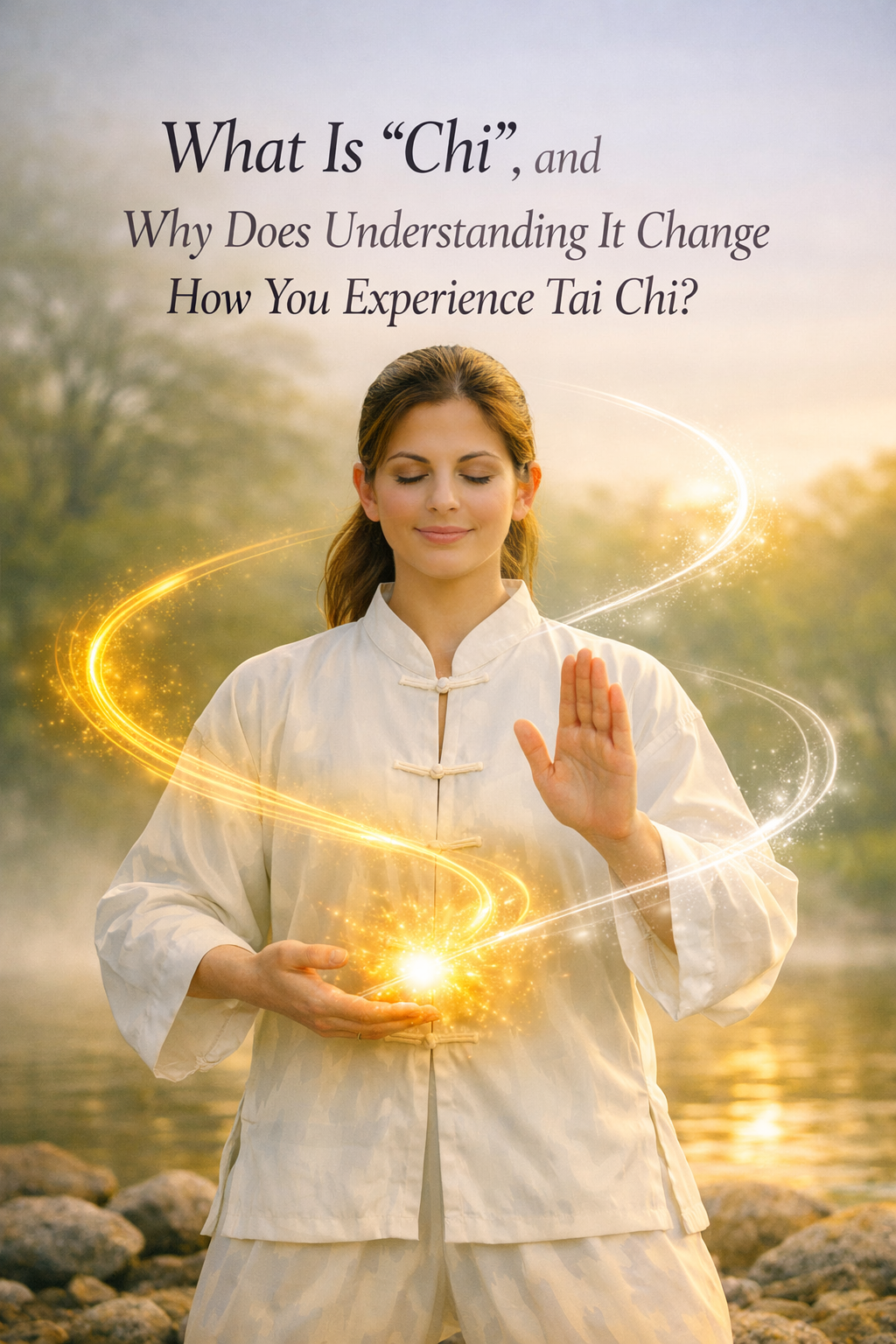
What's helpful for a beginner to understand is that Chi is not something you have to imagine or fake. It's something you learn to feel. And the first place most people feel it is in the hands. When you practice Qigong breathing and move your hands slowly in front of your body, many beginners experience a subtle warmth, tingling, or sense of magnetic resistance between the palms. This isn't a suggestion — it's a genuine physiological phenomenon related to blood flow, nerve activation, and heightened body awareness. It's often the first moment a new practitioner thinks: "Oh. There's something actually happening here."
Understanding Chi also changes how you relate to the movements themselves. Instead of just executing shapes with your body, you start to move with intention — consciously directing your awareness and breath to guide energy through specific pathways. The movement "Two Hands Hold the Heavens," from the Eight Brocades Qigong sequence, for example, isn't just a stretch. As you raise your arms overhead while inhaling deeply, you're consciously opening the chest and drawing energy upward through the body's central channel. The physical action and the inner intention work together, amplifying the effect.
For a beginner, the simplest and most useful thing is to stay curious. You don't need to understand Chi fully before you can experience it. Just slow down, breathe attentively, and pay close attention to the subtle sensations in your body as you practice. Over time, the meaning of Chi will reveal itself through direct experience, which is, according to traditional Qigong teachers, the only way it was ever meant to be understood.