What Stillness Really Means in Tai Chi and Qigong — and Why It's Not What You Think

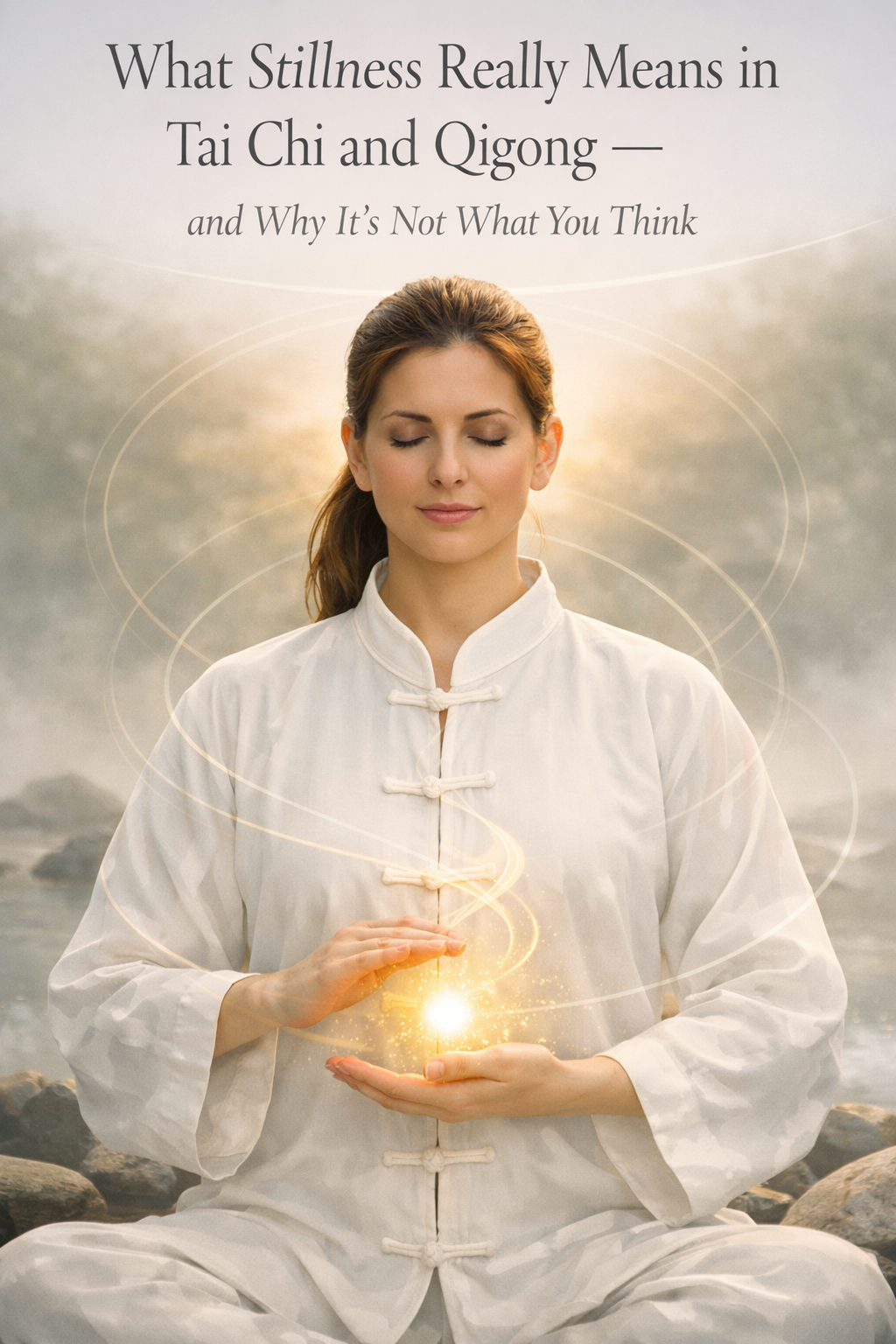
When most beginners hear the word "stillness," they picture someone sitting cross-legged, eyes closed, perfectly peaceful and utterly motionless. That's one kind of stillness — but it's not the kind that Tai Chi and Qigong primarily cultivate, and it's not always the most accessible entry point for people who are new to these practices.
In Tai Chi and Qigong, stillness is better understood as inner quiet within movement. It's not the absence of action. It's a quality of mind that remains calm and uncluttered even as the body moves, even as the breath flows, even as life happens around you. This distinction matters enormously for beginners, because it removes the pressure to achieve some perfect meditative blankness and replaces it with something far more attainable: learning to move with ease, without unnecessary mental noise.
Think about what happens when you move through even the simplest Tai Chi posture. Your mind might want to judge — am I doing this right? It might comment — this feels awkward. It might worry — what if I fall? All of that mental activity creates a kind of static, a friction between you and the movement itself. The practice of stillness in Tai Chi is the gradual quieting of that static. Over time, as the movements become more familiar, the internal commentary fades. What remains is a clean, present awareness — and that is stillness.
The Standing Meditation, or Zhan Zhuang — which translates beautifully as "standing like a tree" — is one of the most direct practices for developing this inner stillness. You stand still, feet shoulder-width apart, knees softly bent, arms relaxed or held slightly forward as if embracing a large balloon. You breathe naturally. And you simply stand. For many beginners, this feels almost impossibly boring at first. But what unfolds within a few minutes is fascinating: you start to notice how loud the mind actually is. Thoughts parade through. The body fidgets. Judgment and restlessness surface. And then — if you continue to stand — something shifts. The fidgeting settles. The thoughts thin out. A quiet quality begins to emerge. That is the beginning of real stillness.
What makes Tai Chi and Qigong unique as paths to stillness is that they develop this quality not through suppression or force, but through gentle, consistent attention. You're not told to clear your mind. You're given something rich to pay attention to — breath, movement, sensation, weight, energy — and through that quality of engaged attention, the mental noise naturally subsides. Stillness isn't achieved. It's uncovered, layer by layer, as the practice deepens.
For a beginner, the most useful thing to know is this: don't chase stillness. Just show up, slow down, and pay attention. The stillness will find you.