Discover How Far You Can Go by Refusing to Quit
Quitting keeps us behind the wall. Persisting is how we find out what lies beyond it, and who we are capable of becoming.

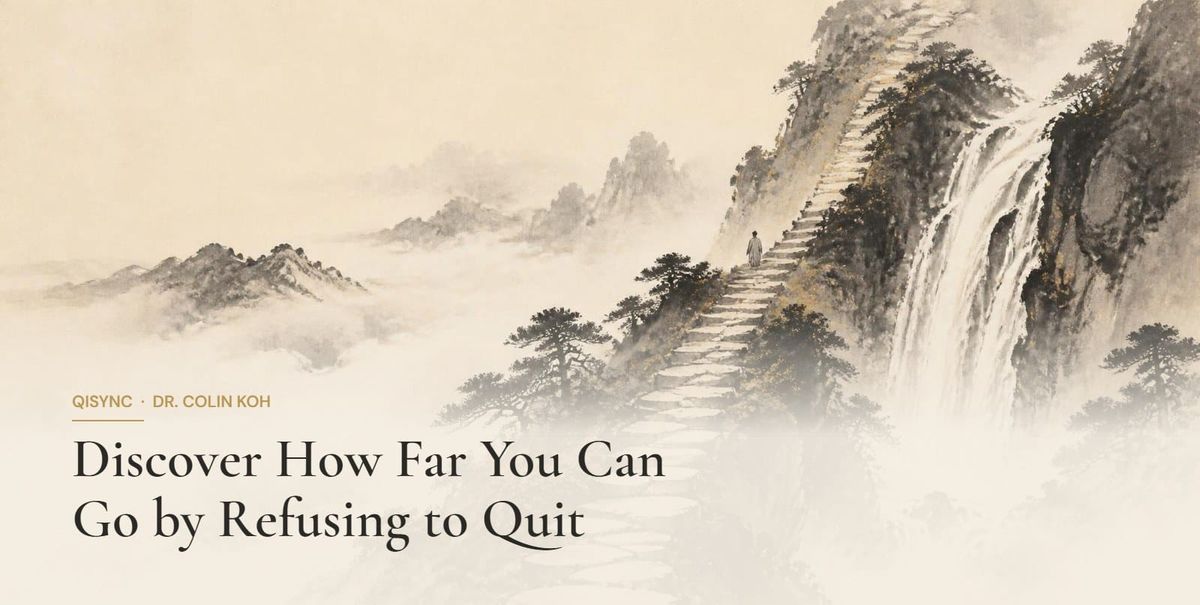
Setbacks, failures and challenges are discouraging. They make us question our approach and our abilities. We wonder whether the goal is worth another attempt. Some people quit at this point. Others pause, retrace their steps, identify what went wrong and adjust. Sometimes we are tempted to give up simply because results did not arrive on schedule, or because someone told us the goal was impossible.
Whatever the reason, quitting tends to cost us more than we realise. Giving up is choosing to remain behind the wall that stands in our way. It prevents us from discovering what we can do and who we can become beyond our fears, our doubts, the opposition we meet and the attempts that did not work. We remain within the limits our circumstances have drawn, and slowly adjust to them.
None of us has an easy path. We are all facing challenges of one kind or another. What often separates those who fulfil their potential from those who do not is attitude, and how far they are willing to go to live their purpose.
“We all have dreams. But in order to make dreams come into reality, it takes an awful lot of determination, dedication, self-discipline, and effort.”
— Jesse Owens
No One Can Take the Step for You
We can stay where we are, explain our situation and wait. Or we can commit to improving our lives, one step at a time. Even if someone kindly offers to pull us out of a difficult place, we still have to face our own fears and take our own steps to sustain the change. Why wait for rescue, or for discomfort to become unbearable, when small steps can begin today? Challenges will always exist. Our task is to prepare for them and learn to use them.
Five Gifts of Refusing to Quit
- Obstacles become easier to handle. Watch a toddler learning to walk. They try, fall, perhaps cry, and try again, improving with every attempt. If they stopped trying for fear of falling, they would not avoid the challenge, only postpone it. The same is true for us. Each time we fall and rise, our skills grow, our tolerance for pressure increases and our minds and bodies adapt. Giving up offers no guarantee that the next path will be easier.
- You never start from zero again. When you persist, every mistake becomes material for improvement. You continue from where you stumbled rather than from the beginning. Small, corrected steps accumulate into something substantial, in our professional and personal lives alike.
- You grow wiser and stronger. People who learn from difficulty, instead of explaining it away, learn faster. Each challenge reveals something about our character and our environment. When we stop seeing setbacks as forces that exist only to break us, we begin to uncover the lessons they hold about who we need to become.
- You find contentment instead of regret. Among the heaviest burdens people carry is the question “What if I had tried harder?” If you give your honest best and still fall short, you can at least rest with a clear conscience. That peace is worth a great deal.
- You discover your inner strength. You never truly know how strong you are until you meet a situation that asks more of you than you thought you had. Persisting through it removes boundaries you did not know you had set.
Capacity Is Built in Stages
In my years in aerospace training, no one was expected to master everything at once. Competence was built in stages, each one laying the foundation for the next. Persistence works the same way. We do not leap from struggling to thriving; we progress through phases, and each phase deserves attention.
Traditional Chinese Medicine shares this view. Vitality is cultivated over time, through daily habits that conserve and replenish our energy rather than exhausting it. Refusing to quit is not about pushing ever harder until we break. It is about building the capacity to keep going, steadily and sustainably, for as long as the journey requires.
When to use it: as a map for long-term growth, especially when you feel you have stalled and want to understand where to focus next.
The QISYNC Lifelong Capacity Pathway describes how human capacity develops in five progressive stages: Relief, Regulation, Resilience, Performance and Healthy Ageing. It begins by easing immediate tension and strain, moves into learning to regulate body and mind, and builds the resilience to persist through adversity. From that foundation, sustained performance becomes possible, and ultimately a life of vitality that lasts. Seen this way, every step you refuse to abandon is part of a longer journey of growth.
Beyond the Wall
The wall in front of you is not the end of the road. It is the edge of what you have explored so far. Keep stepping forward, keep learning and keep building your capacity. You may be surprised by how far you can go.
Discover your next stage of growth. Explore the QISYNC Lifelong Capacity Pathway and the practices that support every step of the journey.
This article is for general wellness education and is not a substitute for medical or psychological advice. Please consult a qualified professional for any health concerns.