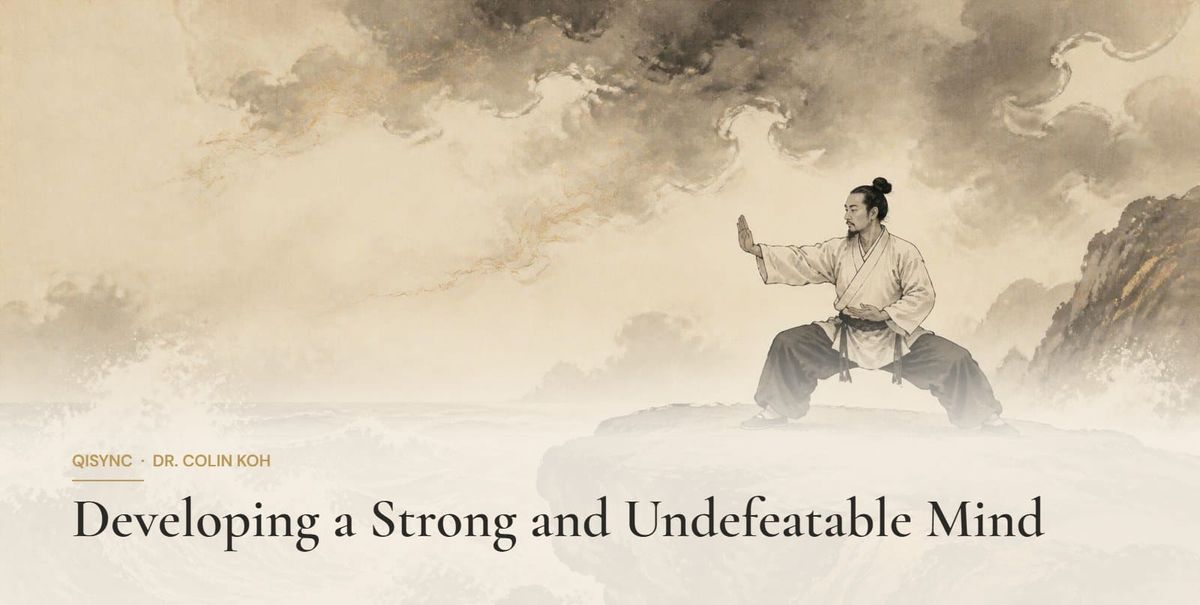
Developing a Strong and Undefeatable Mind
Most of our hardest battles are fought within. Learn to steady the inner world, and the outer one becomes far easier to face.

“There is nothing as powerful as a made-up mind.”
— Les Brown
Every life contains seasons that make us feel as though the ground has fallen away. In those moments, there seem to be two choices. We can move through the difficulty, accepting its lessons and the growth it brings, or we can withdraw, carrying the weight of it with our heads down.
Failure is rarely easy to accept. We are often far less forgiving of ourselves than we would be of anyone else. Each disappointment can raise uncomfortable questions: Am I good enough? Do I really have what it takes? Is the life I hope for meant for someone like me? Many people stop pursuing their dreams at exactly this point, choosing comfort over growth, even when that comfort brings little satisfaction.
Losing a Battle Is Not Losing the War
A strong mind understands that a single loss rarely decides the outcome. It treats each setback as information: a lesson to absorb and apply. It does not deny that the defeat hurt, but it refuses to accept that the defeat is final.
Many people we admire today reached their positions through tenacity rather than ease. They met obstacle after obstacle in building their careers and enterprises, and kept going because they had trained their minds not to read difficulty as a signal to stop.
A Lesson in Endurance
Few modern figures illustrate mental endurance as vividly as David Goggins. A retired United States Navy SEAL and former US Air Force Tactical Air Control Party member who served in the Iraq War, he is also an ultramarathon runner, ultra-distance cyclist and triathlete. In 2013 he set a Guinness World Record for the most pull-ups completed in 24 hours. He is widely reported to be the only member of the US armed forces to have completed Navy SEAL training, US Army Ranger School and Air Force Tactical Air Controller training.
What makes his story instructive is not the list of achievements, but where it began. Goggins has spoken openly about a very difficult childhood and the self-doubt he carried into adulthood. In his memoir, Can’t Hurt Me (2018), he describes how he deliberately trained his mind to keep going long after it wanted to stop. Whatever we think of his extreme methods, the principle is sound: the mind can be trained.
Where Anxiety Lives
“Anxiety in a man’s heart weighs him down, but a good word makes him glad.”
— Proverbs 12:25
This ancient proverb aligns closely with Traditional Chinese Medicine, which holds that the Heart houses the Shen, our mind and spirit. When anxiety and negative self-talk take hold, the Shen becomes unsettled, sleep suffers and judgement clouds. That burden does not stay in the mind. It settles into the body, most often as tight shoulders, a stiff neck and shallow breathing.
In my work in human factors, I have seen how stress narrows attention and erodes performance, even in highly trained professionals. An undefeatable mind is therefore not built by force alone. It is built by learning to recognise tension, release it and return to a calm, clear state, again and again.
Four Practices for an Undefeatable Mind
- Change your perspective. How you view failure shapes what follows. Look beyond the turbulence of the moment. Widen your view, place the setback in its proper context, and keep a clear picture of what success will look like.
- Choose constructive thoughts. Hard times arrive whether we invite them or not. A constructive outlook keeps them from burying us. Train your attention to notice what can be learned and what is still possible, because something useful almost always emerges from difficult seasons.
- Accept change. Change is inevitable. Sometimes it brings good fortune, and sometimes it brings loss. Either way, what serves you is adaptability: the willingness to readjust and put in the work required to fill the gaps that change leaves behind.
- Build resilience daily. Do not wait for a crisis to discover your strength. Strengthen it in small ways each day, so that when the wind howls, you are rooted enough to stand.
When to use it: when worry has settled into your shoulders and neck, after long hours of concentrated work, or whenever you notice yourself bracing against the day.
Neck Relief™ is a QISYNC practice designed to release the tension that stress and anxiety lodge in the neck and shoulders. By easing that physical burden and freeing the flow of Qi through the upper body, it helps the breath deepen and the mind settle. Many people are surprised by how much lighter their thoughts become once the body stops holding on. A calmer body makes a stronger mind far easier to sustain.
Storms Pass
Say no to a defeatist mindset that keeps replaying past mistakes. Periods of hardship are like storms: intense, sometimes frightening, but temporary. It is impossible to live without challenges. It is entirely possible to meet each one with a mind that has been trained to endure, and a body that has been taught to let go.
Begin building that strength today, one calm breath and one deliberate choice at a time.
Release what weighs you down. Explore the QISYNC practice library and begin with Neck Relief™, because an undefeatable mind rests on a body at ease.
This article is for general wellness education and is not a substitute for medical or psychological advice. Please consult a qualified professional for any health concerns.