Resilience: The Real Key to Lasting Success
Success rarely belongs to those who avoid setbacks. It belongs to those who learn to bend, adapt and return to the path.

How far we go in life depends far less on whether we meet difficulty and far more on how we respond when we do. Toughness matters. So does flexibility. But the quality that holds them together is resilience: the capacity to adapt to change, recover from disappointment and keep moving toward what matters.
What we choose to do in uncertain times often decides whether we succeed. Resilient people do not surrender to circumstances. They stay flexible, prepare for more than one outcome, and keep trying when the first, second or third approach does not work. That, more than any single talent, is why they eventually arrive.
Why Resilience Changes Everything
When you are resilient, failures and disappointments lose their power to define you. You see them as temporary conditions rather than final verdicts. Resilience changes the way you think and the way you see. It allows you to adjust plans when situations shift, to keep working after a poor result, and to find a different route to the same destination.
Resilient people also refuse to let external events dictate their inner state. Circumstances may influence what they do, but not who they are. After a hard failure, their question is not “Why me?” but “What have I not tried yet?” And when an outcome cannot be changed, they find a way to say, honestly, “I can be at peace with this,” even if they did not want it.
Resilience is the investor who watches a significant venture fall short, takes stock, and begins again with better judgement. It is not the absence of pain. It is the decision not to let pain have the final word.
Lessons from Water and Bamboo
The Daoist classic, the Tao Te Ching, observes that nothing in the world is softer or more yielding than water, yet nothing is better at overcoming what is hard and strong. Water does not fight the rock. It flows around it, and over time it reshapes the landscape.
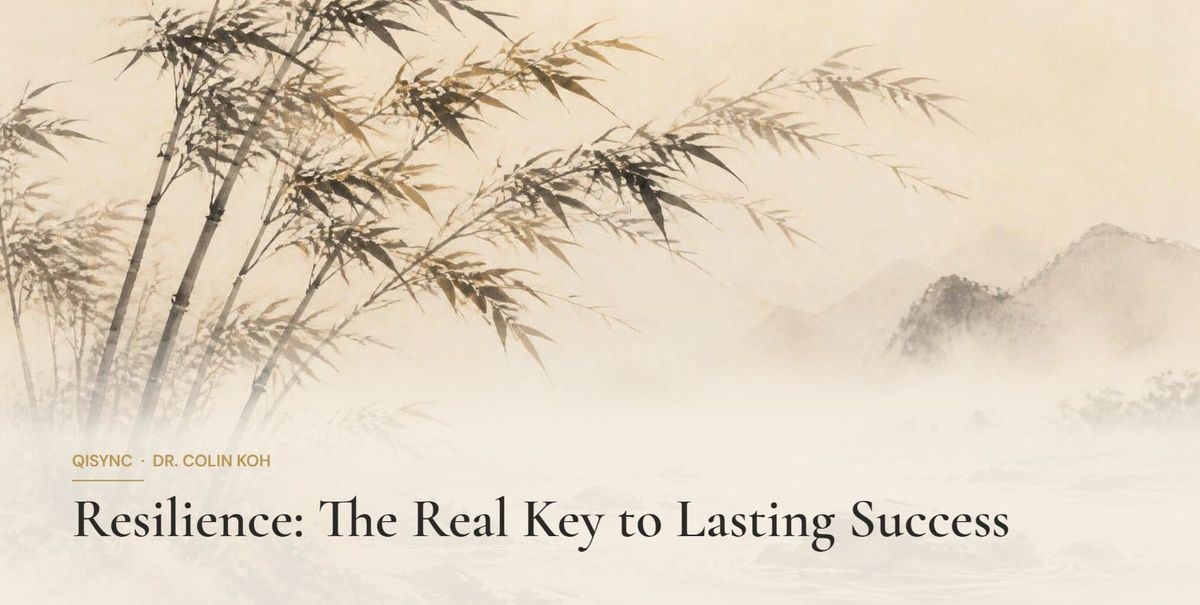
Bamboo teaches the same lesson. In a storm, the rigid branch snaps while the bamboo bends almost to the ground and then rises again. In Traditional Chinese Medicine, this quality of smooth, unobstructed flow is associated with the Liver system, which is responsible for the free movement of Qi. When we are under prolonged stress, that flow tends to become constrained. We grow rigid, irritable and less able to adapt. Restoring flow, in body and mind, restores our ability to bend without breaking.
In aviation and human factors, we see a similar principle. Well-designed systems are not those that never encounter faults. They are those built to absorb disturbances, adapt and recover safely. People are no different.
Four Ways Resilience Moves You Forward
- It helps you accept setbacks. “This is temporary.” “I can try again when the time is right.” Thoughts like these remind you that tomorrow brings another opportunity. Seeing a setback clearly, without exaggerating or denying it, removes much of its sting and frees energy for the next step.
- It changes how you respond to difficulty. When the road becomes hard, do you lose hope, or do you refuse to let the situation define you and look for a way through? Staying constructive under pressure is not easy, which is why so many people quietly give up. Resilience replaces “There is no way back from this” with “How do I keep moving through this?”
- It speeds your recovery from disappointment. Dwelling on failure drains the energy you need to try again. Resilience redirects your attention toward getting back up and toward practical ways of turning an unlikely situation in your favour.
- It helps you adapt to change. There is rarely one road to success. Many people struggle to reach their goals not for lack of ability, but because they cannot adjust when conditions change. Resilience allows you to think on your feet, find new methods and remain ready for whatever comes.
Resilience Lives in the Body Too
We often discuss resilience as a mental attitude, but it is also physical. A nervous system that is constantly on alert finds it difficult to adapt. Shallow breathing, tight shoulders and a restless mind are signs that the body is bracing rather than flowing. At QISYNC, we approach resilience through the 4R Renewal Framework: Reset, Restore, Recharge and Reclaim. Short, regular practices that reset the body during the working day make it far easier to restore perspective and reclaim direction when difficulty arrives.
When to use it: in the middle of a demanding working day, after a difficult meeting, or whenever you notice yourself becoming rigid, reactive or stuck.
Office Reset™ is a QISYNC practice designed for professionals who spend long hours at a desk and under pressure. In a few minutes, and without leaving the workplace, it helps release accumulated physical tension, restore the smooth flow of Qi and bring the mind back to a clear, adaptable state. Used regularly, it turns resilience from an idea into a daily habit, so that flexibility is already available to you when the unexpected happens.
Cultivate It Everywhere
Highly successful people understand that resilience is not reserved for crises. They cultivate it in every area of life: work, relationships, health and personal growth. Each time they are knocked down, they rise again a little wiser and a little steadier.
Resilience is a skill, and like any skill it grows with practice. Begin with small moments: a missed deadline, a difficult conversation, a plan that needs to change. Meet each one with flexibility rather than resistance, and you will find that the larger storms become easier to weather.
Build resilience into your working day. Explore the QISYNC practice library and discover how Office Reset™ and the 4R Renewal Framework can help you bend without breaking.
This article is for general wellness education and is not a substitute for medical or psychological advice. Please consult a qualified professional for any health concerns.